
Food for Thought
Feeding change, one plate at a time
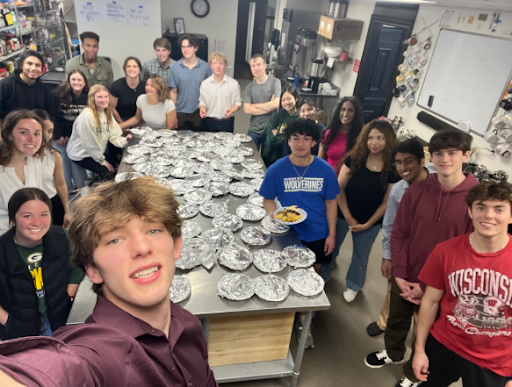
The Food for Thought team prepare meals to distribute
Some students might be overwhelmed with radical change. They might feel they can’t make an impact on their own or that their goal is too lofty to be realistic. Fortunately, that’s not how everyone thinks. The students who make up Food for Thought seek to change the stigmas surrounding homelessness as they build a community that includes the excluded.
Change is something Madison is increasingly familiar with. Recent estimates project Dane County’s population will balloon to nearly 900,000 residents by 2050, a 58% jump from the 2020 census count of 560,000.
Even with efforts at the city and county levels to increase housing supply, rents in Madison have already increased by 47% in the last five years. All of these factors: population growth, housing supply, affordability, and more, like cost of living and access to essential resources are related. Importantly, they all contribute to the quality of community for Madisonians.
One side effect of lacking resources is the inability for some individuals to access stable housing. With prices rising and fewer homes available, this is an issue that Madison will continue to face.
The tragedy is that to many, those experiencing homelessness are invisible. They often do not have access to the broader civic community to find support. This serves as the basis of Food for Thought’s mission.
Like the name suggests, the organization has a “dual mission of not only providing food but also companionship to those without shelter.” Members prepare and distribute meals to people experiencing homelessness. With the food as a launching point for conversation, Food for Thought members then seek to connect over the meal.
Food for Thought co-founder, Jack Kirmeier explains, "we are founded on the idea that the real poverty is loneliness. We want to rebuild community.”
“Our founder in spirit was Paul Selberg. Before [Food for Thought] was an organization, he would make meals for the homeless and then go out and sit with them and eat with them,” Jack says. “And then he figured he might as well try to scale it up. To get more people involved.”
Since then, Food for Thought has grown to more than 150 volunteers. These members, meeting twice a week, prepare more than 300 meals each month.
A day-in-the-life for Food for Thought consists of cooking and connecting. A group of about 15-20 students prepare meals together. This is a great opportunity for Badgers to connect over the organization's purpose.
Food for Thought sources their food from various locations. Volunteers and members of the public are able to donate money which is then used to purchase ingredients. They are also working to partner with organizations like University Dining to source surplus food from dining halls.
The quality of food is important to Food for Thought. “Those without shelter are often given high carbohydrate/sugar filled foods that don’t truly nourish their body. We are committed to serving delicious, nutrient dense meals that provide good sources of protein, healthy fats, fiber, vitamins and minerals,” according to the Food for Thought website.
When the cooking is finished, members take time to reflect and acknowledge their “obligation to serve the underrepresented.” After that, groups of 2-3 members share their meals to spread compassion and strengthen community.
“We act as if there's not some kind of strange barrier; it's refusing to accept that that's how the world is,” Jack says. “Treating people with humanity” is the Food for Thought perspective.
Food for Thought connects with individuals across Madison, from State Street to area shelters. They have also expanded to include Support Teams, which assist individuals in the acquisition of a driver’s license, a job, or housing.
“Food is like a social catalyst,” Jack says. “Maybe it's just a subconscious thing. Or maybe it's just convenience, but it creates a warm environment that grounds the conversation.”
Even on this local level, Food for Thought seeks to enact major change, especially surrounding the perceptions and exclusion toward those experiencing homelessness. Though a nourishing meal and a meaningful conversation, the hope is that people can more feasibly find support.
Down the line, the hope is for individual connections to result in large-scale impacts. “I like to think our idea is bigger than just Wisconsin,” Jack says.
You can read more about Food for Thought at their website or stay up to date with them on Instagram @foodforthoughtmadison. Membership is open to all students interested in making a positive impact and building community.